I’ve been trying to make mandala patterns with oil paints. (Mandala is Sanskrit and means a circle or a disc-shaped object. In Hinduism and Buddhism it is a symbolic pattern used in sacred rituals and as an aid to meditation.) In fact, painting in general is quite meditative. Here is one mandala that has been waiting for its next step. Work on this one has stalled, as I haven’t really come up with a fun twist for it.

A mandala as such didn’t really feel like my thing. I decided to do things a little differently and approached it from my own meditative angle. These paintings have recurring rhythm, light and lots of interesting things to look at. The pictures practically demand that the viewer stop. Stopping makes it possible to discover different paths and patterns. The secret is that you pause for a moment on something that halts everyday, stressful thinking.
Winter
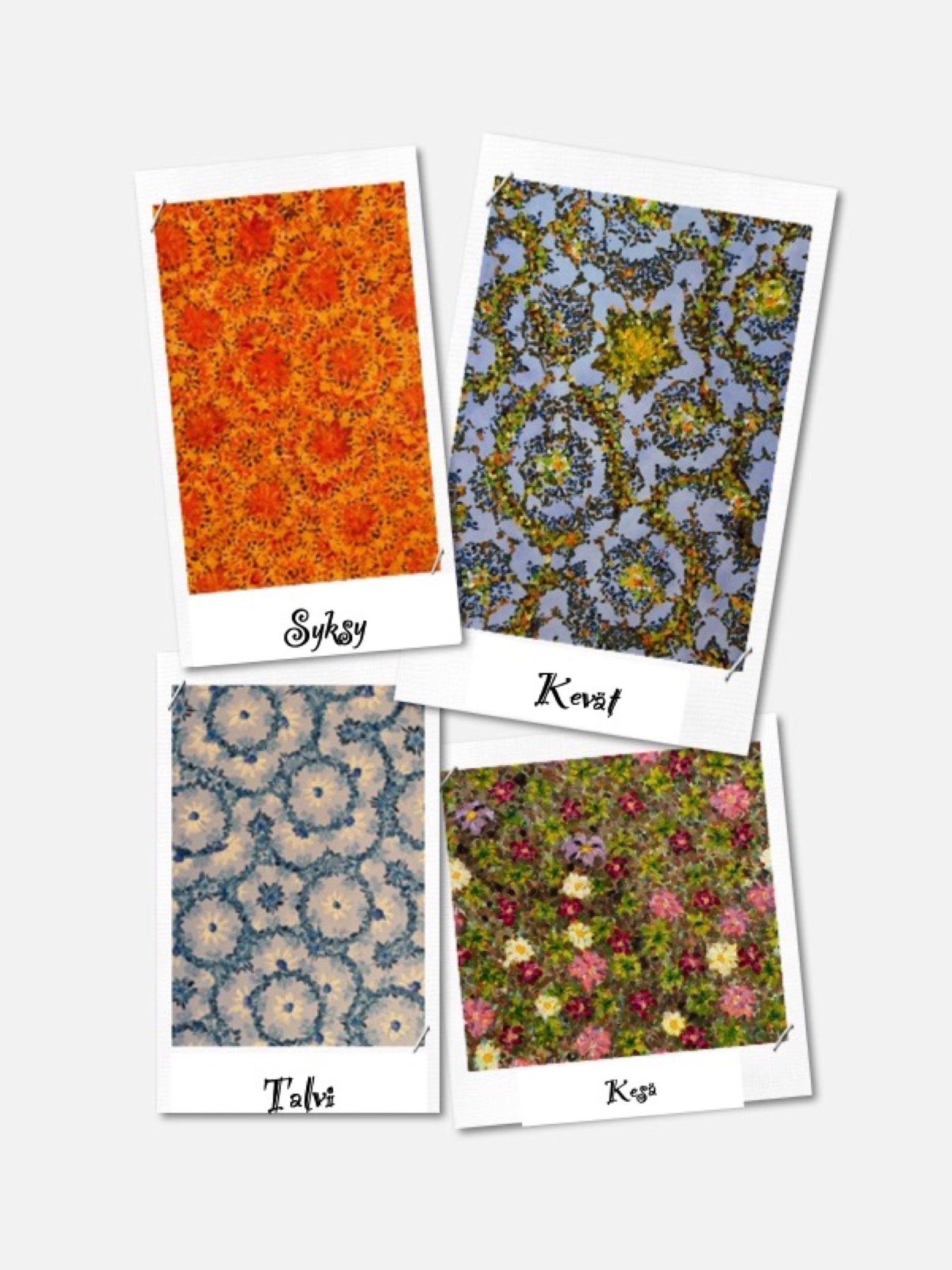
This winter painting was the first one I made. While painting it I realised right away that this is a fascinating pattern and it looks interesting. This oil painting measures 1 m x 50 cm. What makes the pattern fascinating is that it has lots of recurring elements, yet no line really repeats. Maybe you’ll find the ice crystals of a cold winter in it.

Spring
Spring was the most challenging of the paintings. At first it had much more clearly defined flowers, which actually belonged to summer. I faded the flowers out and gave the painting more of the freshness and brightness of spring. Can you find lines it shares with winter?

Summer
The summer painting was originally much more yellow. While painting the flowers I made it a little darker, which helped the flowers show and stand out better. Can you find the same lines in the summer painting as in the others?

Autumn
Autumn was the last of the paintings to be made. My original idea was to make autumn browner in tone. I thought about my autumn-themed paintings and decided that this one, too, would get more light and colour.

All four paintings are oil paintings of the same size. They are a metre high and 50 cm wide.
I think of each painting as the human mind at different moments. Lots of thoughts, stimuli pulling in different directions, and never a moment to stop. The patterns depict the movement of the mind. Thoughts leap between negative and positive, seek confirmation from one another, cling to memories, learned patterns and past experiences. One thought gives rise to another – and soon the mind is full of a story we have built ourselves in our imagination.
Look at the background of the paintings. See past the patterns to the single colour. It is quiet, steady and peaceful. It doesn’t demand attention, but it carries everything else. In that colour lies a space where there are no thoughts yet – or where they no longer rule. A peace that is always present, even when the mind is churning on the surface.
Reaching this peace is possible for each of us. But it doesn’t happen by forcing it or by fighting our thoughts. It begins with awakening: with recognising our own thought patterns and seeing how they steer us.
When you recognise thoughts as thoughts – not truths – the background colour begins to show more clearly.
And perhaps then the winter landscape isn’t cold after all, but clear and calm.
The pattern I’ve used in the paintings is a so-called Penrose tiling, a way of covering a plane with two kinds of shapes so that the same pattern never repeats in exactly the same way. Even though the lines are arranged without regular repetition, they still form a fascinating, continuous and orderly surface. Mathematically the pattern is based on the golden ratio, which gives the structure five-fold symmetry. Named after its inventor Roger Penrose, the method revolutionised our understanding of how complex structures can arise from simple parts. The pattern is related to the girih ornamentation used in the Middle East, so these paintings didn’t end up all that far from mandalas after all.