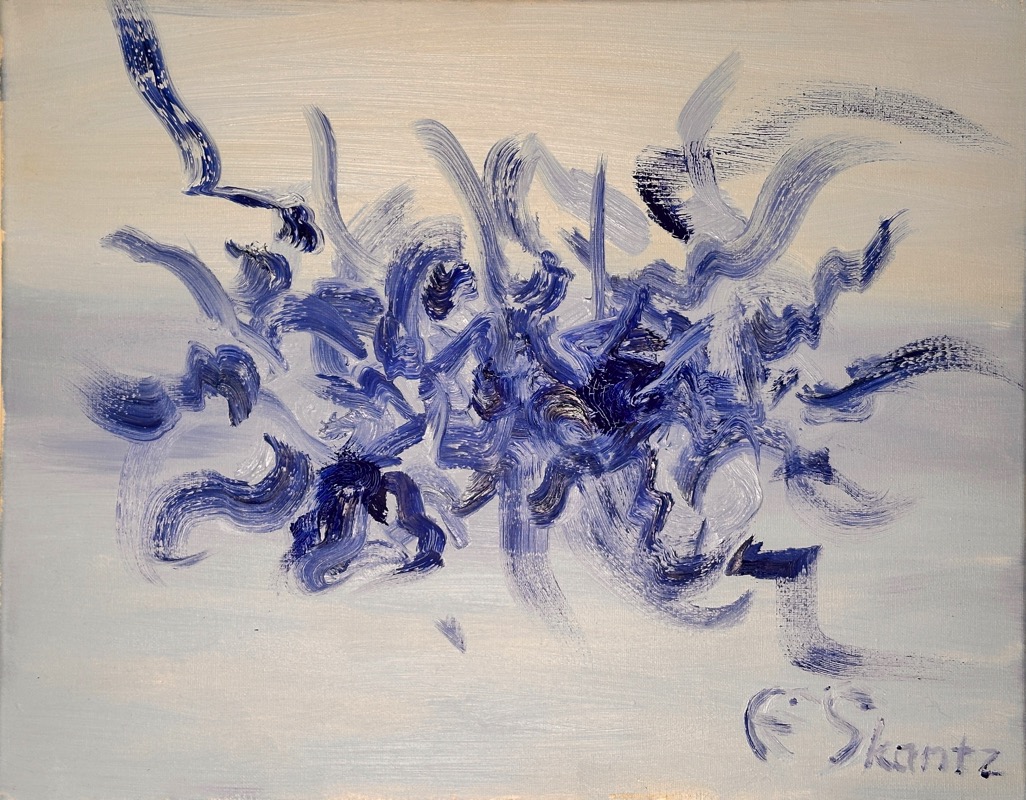
This painting is especially dear to me. It was made in summer 2023, soon after I rediscovered the joy of painting – the lightness that comes when you let the brush move without demands or expectations.
“Moments in Time” doesn’t depict anything concrete, and that is exactly where its magic lies. Every brushstroke was made with an empty mind, fully present in the moment. That was when I found a simple but powerful way to calm my thoughts, and it freed me from my inner critic – that demanding voice that always wanted more, better, more perfect.
When that voice fell silent, joy took its place. Freedom. Trust that art can come into being in its own time. This technique has stayed with me ever since and given my inner artist room to breathe.
What makes this oil painting special is that it doesn’t try to depict anything – yet it can still say a lot. When you stop in front of it, you might notice that you see in it exactly what you need. Perhaps peace, perhaps colours, perhaps something you didn’t know you were looking for.
Emptying the mind as a technique is ultimately very simple – and at the same time endlessly relaxing. It’s like a little breather in the middle of everyday life, and that is exactly where this work came from.
A tip for the anxious artist
Here’s a tip for every artist who finds painting stressful: find a quiet, peaceful place. Take your familiar painting or drawing tools. The medium doesn’t matter – I use oil paints myself. The canvas doesn’t matter either; it can even be an old work that for one reason or another didn’t work or was never good enough for you.
The painting process is very simple, because it focuses more on your state of mind than on the painting itself. Your inner censor, your critic and your thoughts step aside as your breathing leads you into deep calm. Emptying the mind happens through the breath.
Put a dab of paint on your brush. Look at the spot where you’re going to apply it. Breathe out calmly – all the air out of your lungs. Your diaphragm can still push your lungs up a little more. When all the air is out, wait until your body starts signalling that it needs oxygen. If something is still “buzzing” in your mind, wait a little longer.
Just before you breathe in, open your eyes, let the brush fly across the canvas and see what happens. The brush moves before your thoughts and inner censor can catch up. The painting doesn’t depict anything – and that’s exactly why it can’t possibly fail.

What’s also fascinating about the painting above is how much paint I used. I often look at it and wonder whether I should try making something similar now.
How I set myself free…
Here are a few examples of how I broke free from the chains of self-censorship. The one below was a painting of the islands of the Airisto. I had already learned a little painting technique, but even so, my inner censor wasn’t happy with the landscape. This canvas has probably been reused at least three times. A bit like in music, I started remixing my own paintings. In a remix, something old is recycled in a new way.

Here is a smaller painting that turned into a sea monster in the remix – or however each viewer sees it.

Back when I made these paintings, I had no idea about colours, colour theory, what pleases the eye and so on. That understanding came later through experience. This “businessman grasps the beauty of the moment” was a painting through which I wanted to depict my own feelings. As you can see, the use of colour was still wild, and the painting includes my own gravestone, which instead of rest in peace reads L.I.P – Live in peace. At the time of this painting, my head wasn’t buzzing with worries or with imaginings about the future or the past.

My current paintings still follow that same path. I try to find my inspiration in the place where there are no thoughts. “Thinking outside the box” only works once you switch off your thoughts and close the whole “box”. By switching off your thoughts you reach a state where there is no box at all.